
Top 3 Indian Defenders at the 2026 Asian Games: Jaideep Dahiya, Rahul Sethpal & Sumit Sangwan
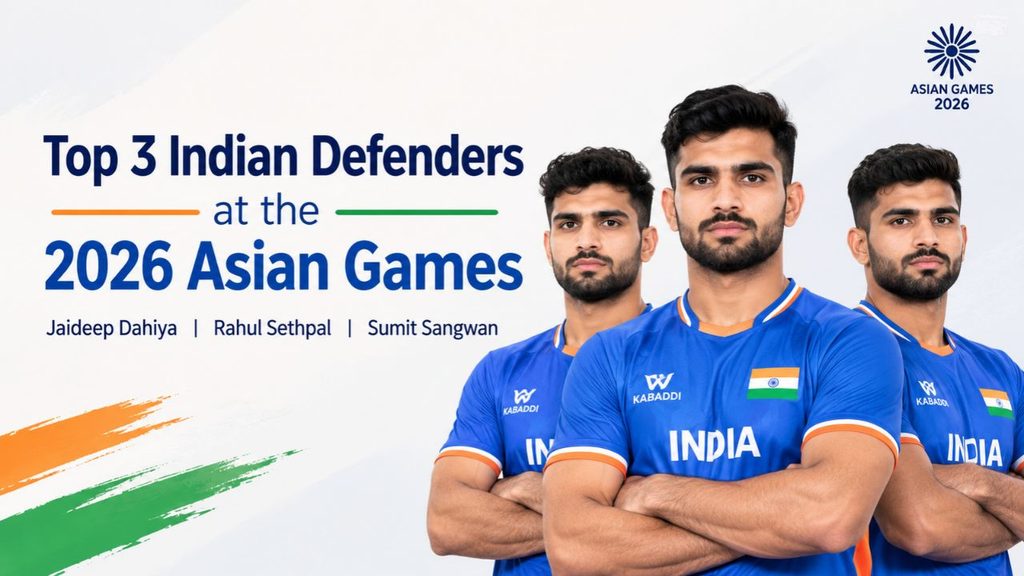
Top 3 Indian Defenders at the 2026 Asian Games: Jaideep Dahiya, Rahul Sethpal & Sumit Sangwan
India’s men’s kabaddi team gave another brilliant performance at the 2026 Asian Games in Aichi-Nagoya, Japan on September 26 by beating Iran (40–34) to clinch gold. The raiders of India played a major role in leading the team to success while making sure that they need to lead thanks to their defenders, who also did perfectly well throughout all three stages of competition.
With 17, 16 and 15 tackle points respectively, Jaideep Dahiya, Rahul Sethpal and Sumit Sangwan became the top three defenders for India. Their efforts not only ensured India went through the competition unbeaten but also to yet another men’s kabaddi gold medal at Asian Games, its ninth overall.
The performance of their respective roles, defence responsibilities, and key contributions are analysed below along with the overall impact of India’s defensive efforts in this tournament.
Top 3 Indian Defenders at the 2026 Asian Games
India’s defensive unit produced consistent results throughout the competition. Jaideep Dahiya finished at the top of the tackle-points chart, followed closely by Rahul Sethpal and Sumit Sangwan.
The following table presents their reported tournament statistics.
| Rank | Defender | Tackle Points | Raid Points | Total Points |
| 1 | Jaideep Dahiya | 17 | 0 | 17 |
| 2 | Rahul Sethpal | 16 | 0 | 16 |
| 3 | Sumit Sangwan | 15 | 0 | 15 |
The difference between the first and third positions was only two points. This close competition highlights the contributions of multiple defenders rather than a defensive strategy dependent on one standout player.
1. Jaideep Dahiya: India’s Leading Defender
It could be noted that Jaideep Dahiya had scored highest Gadra points for India ie. 17 tackle point throughout the campaign and finished in top spot of Asian Games defensive standings as well. He made his continental event debut and put up a memorable performance to turn out as one of the mainstays for India in their quest.
Jaideep, being a cover defender in his primary role was tasked with assisting to nullify the attacking opposition and organizing defensive shifts. The cover defenders must have a quick and accurate anticipation to come in along with the raider as it is all about timing, if they are able hit opponents accurately than nothing like that.
Jaideep Dahiya’s Asian Games Performance
| Statistic | Performance |
| Tackle points | 17 |
| Raid points | 0 |
| Total points | 17 |
| Defensive position | Cover |
| Asian Games experience | Debutant |
The results of the group stage showed that defending well is essential. India held Chinese Taipei to 21 points, Japan to 24 points, and Bangladesh to 25 points. This shows how successfully India was able to stop its opponents from scoring.
After a successful Pro Kabaddi League Season 12 campaign where he is said to have accumulated 68 tackle points, Jaideep then joined the competition. This was a great accomplishment for him to carry his success from the Pro Kabaddi League into an international competition.
He was the top-scoring Indian defender at the Games because of his positioning, strength, and timing in making tackles. Now with experience from playing internationally to supplement his domestic performance, he continues to build on the fact that he is a vital member of the Indian kabaddi team.
2. Rahul Sethpal: A Reliable Corner Defender
India’s second most successful defender around the Supplemental Auction was Rahul Sethpal, who returned from Bengal Warriors with 16 tackle points. Another debutant, he helped to keep India’s defensive shape constant.
The position of corner defender in Kabaddi is the hardest role to fill. They have to assess which direction a raider is headed, decide when and how best to make that tackle while communicating with one another in order to stop any potential escape. Timing is everything, and bad timing can hand the enemy a point on your dollar.
Rahul Sethpal’s Asian Games Statistics
| Statistic | Performance |
| Tackle points | 16 |
| Raid points | 0 |
| Total points | 16 |
| Defensive position | Corner |
| Asian Games experience | Debutant |
Rahul’s 16 tackle points put him just one point shy of Jaideep. He was one of many who were back in great rhythm as India racked up a series of comfortable wins.
India went on to win over Thailand 66–28 in the semifinal and Republic of Korea, who they had already beaten during group stages by a score line of 63–31. The way the team was able to marry together attacking pressure with good defensive control — these were on display in those matches.
Rahul’s contribution was even more essential given how India did not depend solely on its raiders for victories. The defense unit regularly set opportunities for the attack, by stopping raids from rivals and not allowing scoring chances.
For the corner defender, six points was an impressive tally on his debut at Asian Games 2. His performance also highlighted the necessity of having at least two solid defenders in a title-winning team.
3. Sumit Sangwan: An Important Part of India’s Defence
Interception also came from Sumit Sangwan, who had 15 tackle points to complete the top trio of defenders for India He, too, drew from the collective experience of Jaideep and Rahul going into the tournament with no prior exposure at Asian Games but performed strongly against some of Asia’s top kabaddi sides.
Playing at corner-back, Sumit played in one of the systems with interdependencies and communication between defenders (high press and collective responsibility). As a corner, you have to react instantly when the raider tries to make his move and exit2 or change direction on your side of that boundary.
Sumit Sangwan’s Tournament Numbers
| Statistic | Performance |
| Tackle points | 15 |
| Raid points | 0 |
| Total points | 15 |
| Defensive position | Corner |
| Asian Games experience | Debutant |
Sumit was just two tackle points adrift of Jaideep, showcasing how closely-matched were India’s top defenders in terms of tournament scoring.
He also played a significant role in helping India win the gold medal. The final against Iran was closer than most of India’s previous matches, with India only down 17–18 at half-time. But the team managed to bounce back and win 40–34.
Simply making all of those raids need not be enough for a comeback in such a match. The defenders must ensure that the opposition does not increase its lead and at the same time provide their raiders a chance to turn things in favour of his team. The defensive effort was a key part of that Indian recovery.
Sumit regained 15 tackle points, reaffirming the depth in India’s defensive department. In his first ever tournament he laid the groundwork for many more international appearances to come.
How India’s Defence Helped Secure the Gold Medal
Highlights India remains unbeaten during the 2026 Asian Games win in full mount Work from either side of the mat made up India’s success The raiders scored points. The defenders fought to contain and control the tide when it was hard for them.
Perhaps the most positive was that it looked like they weren’t solely relying on individual performances to carry them; you could sense a growing confidence in warm-ups and togetherness approach, as if team might now be seen more important than ‘me’ for this group. Jaideep topped the tackles chart, Rahul in particular was a consistent performer from his corner position throughout and Sumit brought another solid defensive choice.
India’s reported results throughout the tournament were as follows:
| Stage | Opponent | India’s Score | Opponent’s Score | Result |
| Group stage | Chinese Taipei | 37 | 21 | India won |
| Group stage | Japan | 49 | 24 | India won |
| Group stage | Bangladesh | 48 | 25 | India won |
| Group stage | Republic of Korea | 63 | 31 | India won |
| Semifinal | Thailand | 66 | 28 | India won |
| Final | Iran | 40 | 34 | India won |
These results show that India maintained a strong scoring record while limiting the opposition in every match listed above.
The final against Iran was the closest contest of the campaign. India’s ability to turn the match around after falling behind at half-time demonstrated the value of staying composed under pressure.
India’s Complete Player Points Table
Although the defenders attracted attention for their tackling performances, India also benefited from a productive raiding unit. Devank Dalal finished as the leading points scorer among the Indian players listed in the supplied tournament statistics.
The table below provides the reported raid points, tackle points and combined totals for the squad.
| Player | Raid Points | Tackle Points | Total Points |
| Devank Dalal | 59 | 1 | 60 |
| Arjun Deshwal | 35 | 0 | 35 |
| Ayan Lohchab | 35 | 0 | 35 |
| Ashu Malik | 31 | 0 | 31 |
| Aslam Inamdar | 21 | 2 | 23 |
| Jaideep Dahiya | 0 | 17 | 17 |
| Rahul Sethpal | 0 | 16 | 16 |
| Sumit Sangwan | 0 | 15 | 15 |
| Ankit Jaglan | 0 | 9 | 9 |
| Pawan Sehrawat | 8 | 0 | 8 |
| Sunil Kumar | 1 | 5 | 6 |
| Gaurav Khatri | 0 | 4 | 4 |
According to these figures, Devank Dalal led the Indian team with 60 total points. Arjun Deshwal and Ayan Lohchab followed with 35 points each, while Ashu Malik contributed 31.
Among the defenders, Jaideep, Rahul and Sumit were the top three players by tackle points. Their performances complemented the work of the attacking players and helped India maintain a well-rounded team structure.
Sunil Kumar’s Role as India’s Captain
Sunil Kumar was skipper of the gold-medal-winning Indian men’s kabaddi team. He was not the only one to solo an event in Korea – as a cover defender himself he added experience and leadership to what was largely a rookie Asian Games squad.
In the last match he was able to score 5 tackle points and one raid point, resulting in his return for tournaments. While his personal points total ranked behind those of the three leading defenders, contributions from a captain cannot be measured in simple numbers.
Effective communication, coordination and decision-making is an important aspect of kabaddi for typically when raiders are flying all over the mat defenders need to be in sync with each other. The gaps can be reduced and players are able to support each other whenever they go into tackles.
As a result, Sunil was a key component of the greater team endeavour. One of the reasons was also due to great performances from Jaideep, Rahul and Sumit that showed how well all four members in their defensive group worked together throughout this campaign.
What Makes Jaideep, Rahul and Sumit Stand Out?
Of the three defenders, all had a common thread: they were strong in their first Asian Games campaign. With a combined reported tally of 48 tackle points, they have an important role to play in India’s defence.
A number of characteristics account for their contributions.
1. Consistent tackling: No player finished with fewer than 15 tackle points to provide India three reliable defensive sources of resistance.
2. Different defensive roles: Jaideep at cover and Rahul, Sumit from the corners in different defensive roles. This mix of personnel also provided much-needed balance up and down the defensive board.
3. Teamwork under pressure: More than 1 v 1 battles, kabaddi defence relies on teamwork as all the players come together by moving in perfect sync. The optimal use of collective action was illustrated by the result achieved by this team.
4. Experience gained through domestic competition: Games played in Pro Kabaddi League provide players with great exposure on timing, match interaction and understanding of pressure. One of the foremost examples was Jaideep’s reported Season 12 tally, translating into the international arena.
The narrow margin between their two tackle-point totals also indicates that they had played a few players who could make an impact while defending.
Read More: Mohammadreza Shadloui Salary 2026 || Asian Games 2026 Kabaddi
FAQs
Who was India’s best defender at the 2026 Asian Games?
Jaideep Dahiya was India’s leading defender according to the supplied statistics, finishing with 17 tackle points.
How many tackle points did Rahul Sethpal score?
Rahul Sethpal recorded 16 tackle points, placing him second among India’s defenders in the reported tournament figures.
How many points did Sumit Sangwan score in defence?
Sumit Sangwan collected 15 tackle points, finishing third among India’s leading defenders.
Who captained India’s men’s kabaddi team at the 2026 Asian Games?
Sunil Kumar was reported as the captain of India’s men’s kabaddi team during the tournament.
Did India win the men’s kabaddi gold medal in 2026?
According to the supplied match report, India defeated Iran 40–34 in the final on September 26, 2026, to claim the men’s gold medal.
Who scored the most points for India in the supplied statistics?
Devank Dalal topped the listed points chart with 60 points, including 59 raid points and one tackle point.
Why were India’s defenders important to the gold-medal campaign?
The defenders helped restrict opposition scoring, create opportunities for raiders and maintain team balance. Their combined contributions supported India’s unbeaten run in the reported tournament results.
Conclusion
Importance of well-rounded kabaddi team In its reported gold-medal campaign at the 2026 Asian Games. Jaideep Dahiya topped the defensive standings with a tally of 17 tackle points, followed by Rahul Sethpal (16) and Sumit Sangwan (15).
Both showed how tackling, positional awareness and cooperation assist in a championship winning effort. India’s raiders provided most of the scoring, but its defenders played an equally significant role in dictating games and handling pressure.
For its three players Jaideep, Rahul and Sumit, the tournament was also a landmark international event. Their performances also displayed signs of strength in Indian kabaddi’s defensive mix and proved they will be ones to watch over the years ahead.