
Rules of Kabaddi: Match Format, Scoring Rules, Fouls, and Player Roles
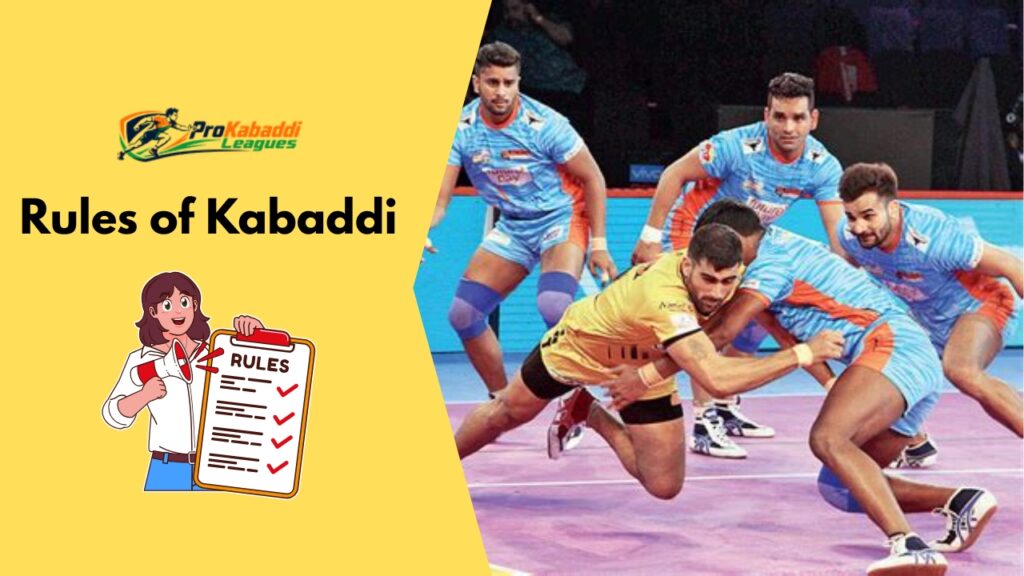
Rules of Kabaddi
Kabaddi is one of the fastest and most thrilling games in the world to be played on a daily basis. The sport from India that involves physical strength, agility, strategy, and teamwork. As a matter of fact, whether you are new to kabaddi or a player, coach, or sports lover, the rules and how to play kabaddi are what every single person should know in order to enjoy the game well.
This is a detailed guide to the rules of Kabaddi, starting from the court size, scoring system, player roles, fouls made, and rules of the match in simple language.
What is Kabaddi?
Kabaddi: Kabaddi is a team sport between two teams of seven players. The aim is simple enough: the raider enters into the opponent’s half, tries to tag defenders, and then returns successfully to his side without being tackled. Defending players attempt to prevent the raider from turning.
History of Kabaddi
The roots of kabaddi are considered to go back over 4000+ years to ancient India. It is now played professionally through leagues such as the Pro Kabaddi League (PKL) and international tournaments organized by governing bodies. It is playable worldwide owing to solid gameplay and its strategic depth.
Kabaddi Court Dimensions
Understanding the playing area is one of the most important aspects of the rules of kabaddi.
Men’s Kabaddi Court
| Measurement | Size |
| Length | 13 meters |
| Width | 10 meters |
Women’s Kabaddi Court
| Measurement | Size |
| Length | 12 meters |
| Width | 8 meters |
The court is divided into two equal halves by a midline. Important markings include the baulk line, bonus line, and lobby area.
Important Court Lines in Kabaddi
1. Midline
The midline is the center line that divides the court into two equal halves. Each Raid Zone has this line, and if the Raiders pass it, they will begin a real Raid.
2. Baulk Line
For men, it is around 3.75 meters from the midline where they see the baulk line being established on either side of that ridge.
To be valid, a raider must touch a portion of the opponent’s court on the other side of the baulk line. Otherwise, the raider will be declared out.
3. Bonus Line
The bonus line is located 1 meter past the baulk line.
This is the line that a raider must successfully cross in order to receive 1 technical bonus point, under certain conditions (typically at least six defenders on court).
4. Lobby
The lobbies line both edges of the expanse.
These areas only come into play after physical interaction has been made between the raider and defenders.
Number of Players in Kabaddi
Each team consists of:
| Category | Number |
| Players on Court | 7 |
| Substitute Players | Up to 5 |
| Total Squad Size | 12 Players |
Seven players play at a time while the remaining players serve as substitutes.
Duration of a Kabaddi Match
A standard professional kabaddi match consists of:
| Phase | Duration |
| First Half | 20 Minutes |
| Half-Time Break | 5 Minutes |
| Second Half | 20 Minutes |
Total playing time is 40 minutes. Teams switch sides after halftime.
Basic Rules of Kabaddi
Rule 1: The Raid
A player from the attacking team enters the opponent’s court to score points.
The raider’s objective is to:
- Touch one or more defenders
- Return safely to their side
- Avoid getting tackled
Every attack is called a raid.
Rule 2: Raid Time Limit
Modern kabaddi allows a raid duration of approximately 30 seconds.
The raider must complete the raid and return before the time expires.
Rule 3: Valid Raid
For a raid to be considered valid:
- The raider must cross the midline.
- The raider should cross the baulk line.
- The raider must return safely to their half.
Failure to meet these conditions can result in the raider being declared out.
Rule 4: Touching Defenders
Every defender touched by the raider earns the attacking team one point.
The raider must safely return to his side for the points to count.
Rule 5: Tackling the Raider
Defenders earn points by stopping the raider from returning.
A successful tackle results in:
- Raider being declared out
- Defending team earning one point
Kabaddi Scoring Rules
The kabaddi scoring rules are crucial for players and fans both since every raid and tackle can make a difference between winning or losing. Teams score points by raiding successfully, tackling members of the opposite team, attempting at bonus line penalty corners and special situations like All-Outs and Super Tackles. And, the team with the most points shall be declared as the match-winning team at the end of the match.
1. Raid (Touch) Points
During a raid, a raider gets one point for each defender they touch if the raider returns to their half without being tackled. If a raider gets multiple tags in a single raid, then the team is awarded one point for each defender out. Hitting three defenders and touching the ground again without getting caught gets you three raid points, for instance.
2. Tackle Points
A defensive team is awarded a tackle point when they successfully prevent the raider from returning to their side of the court. If successfully tackled, the raider is ruled ‘out’, and one point is awarded to the defenders. Tackle points are vital for getting defenders back into the game and bringing teammates back into play.
3. Bonus Points
A raider can get one extra point for crossing the bonus line under necessary conditions. This bonus line can only be used when the defensive team has six or more players on court. If however the raider is ultimately tackled, even then, if he has been successful in completing his bonus before being toppled over, this point remains to be counted in your score.
4. All-Out Points
An All-Out^1 is popularly known as a situation where all seven players of a team have gone out. The rival side is awarded two points as an All-Out bonus, while every player of the team that has been eliminated goes back to life, and they return to the court. All-Outs frequently have some of the largest score differences and can provide a major shift in momentum in a match.
5. Super Tackle Points
Super tackle: An action when the defending team has three or fewer players remaining on the mat, in which he successfully tackles a raider. Today in professional kabaddi, whereas one point is awarded for a successful tackle, in the realm of modern-day defensive plays, a Super Tackle amounts to two points – making it one of the most valuable defenses in the game.
6. Super Raid Points
When a raider scores 3 points or more on one raid, it is termed a Super Raid. This is done through touch points as well as bonus factors. The pure fact that Super Raids can turn the game with one shot makes them huge, as they not only decrease defenders but also create space for an All-Out.
7. Technical Points
Technical points can also be given to a team if the opponents breach any of the rules. Common reasons include:
- Players stepping out of bounds.
- Illegal tackles or dangerous play.
- Delaying the game intentionally.
- Incorrect player positioning.
Infringement type dictates how a technical point is scored the referee will award one, and these can be decisive in close matches.
Quick Summary of Kabaddi Scoring
| Scoring Method | Points Awarded |
| Touch Point | 1 point per defender touched |
| Tackle Point | 1 point |
| Bonus Point | 1 point |
| All-Out | 2 bonus points |
| Super Tackle | 2 points |
| Super Raid | 3 or more points scored in a single raid |
| Technical Point | 1 point (depending on violation) |
Kabaddi‘s scoring system rewards both attacking and defensive excellence. Successful raiders can accumulate points quickly through touch points and bonus points, while defenders can make a strong comeback through tackle points and Super Tackles, making every second of the game highly competitive and exciting.
Kabaddi Players: Mohammad Reza Shadloui | Pardeep Narwal | Arjun Deshwal
Revival Rule in Kabaddi
The Revival Rule is one of the more strategic elements in matches of kabaddi. But when a team wins a point via a successful raid or tackle, one player already out of play returns to the court. Players return back in the same order as they were declared out, which helps teams rebuild their strength, maintain balance on both sides of the ball and create scoring opportunities for a comeback throughout the match.
Common Fouls in Kabaddi
As with any competitive sport, kabaddi has a code of rules that players must accept and follow in order to play safely and fairly. Infringement of these rules is regarded as a foul and leads to the awarding of points (in some cases) to the opposing side or various other punishments. By understanding common fouls, players can learn to avoid unnecessary errors and keep their discipline in games.
Common Raider Fouls
- Leaving the boundary line while being uncontested by a defender
- In a raid, not crossing the baulk line.
- Exceeding the allowed raid time.
- Going to court before his referee signal
- Engagement in illegal moves or unsportsmanlike acts.
Common Defender Fouls
- This includes holding on to a raider’s hair, jersey, or any other parts of the body that is not permitted.
- Unlawfully forcing a Raider out-of-bounds
- Dangerous or violent tackles that can cause injury.
- Crossing the Mid-Line Before the End of a Raid
- Deliberately running out the clock or disputing calls with officials.
Technical Fouls
Technical fouls are called for a violation of the rules regarding how teams must conduct themselves in relation to each other and the match, such as having too many players on the court, coaching interference during play, or delaying restarts. This can lead to awarding technical points for a rival team.
Winning Rules in Kabaddi
A team wins when it has more points at the end of regulation time.
| Result | Outcome |
| More Points | Win |
| Equal Points | Tie or Tiebreaker (Tournament Rules) |
Most leagues use specific tiebreaker procedures if knockout matches end in a level.
Also Read: All Pro Kabaddi 2025 Players List | Thyagaraj Indoor Stadium Delhi
Player Positions in Kabaddi
A kabaddi team has seven players on the court, and each player plays a role that is essential to success. Kabaddi has three main types of positions: Raiders, Corners, and Covers, each requiring different skill sets and responsibilities. A minimum number of each position in a variety, supplementing each other as needed, to do as much attacking and defending as possible.
Raider
The attacking players are known as raiders: they enter the opponent’s half, score points by touching their defenders, and safely return to their side. They build around their super-speed, agility, footwork, and their ability to think on their feet by tricking defenders into earning valuable raid points.
Key Skills:
- Speed and agility
- Strong reflexes
- Tactical awareness
- Excellent balance and flexibility
Corner Defenders
Corner defenders occupy the left and right corners of the defensive formation. They are usually the team’s strongest tacklers and are responsible for stopping raiders using ankle holds, thigh holds, and diving tackles. Their role becomes especially important during crucial defensive situations.
Key Skills:
- Powerful tackling ability
- Quick reactions
- Strength and balance
- Defensive coordination
Cover Defenders
Cover defenders stand next to the corner players and provide support during tackles. They work closely with corners to block raiders, close gaps, and prevent escapes. Covers play a major role in team defense and often initiate coordinated tackles.
Key Skills:
- Team coordination
- Strong upper-body strength
- Tactical positioning
- Effective blocking techniques
All-Rounders
An all-rounder is a versatile player who can contribute effectively in both raiding and defending. These players provide flexibility to the team and can adapt to different match situations when needed.
Key Skills:
- Balanced attacking and defensive abilities
- High stamina
- Game awareness
- Adaptability under pressure
Quick Overview of Kabaddi Positions
| Position | Primary Role |
| Raider | Score points through raids |
| Corner Defender | Execute tackles and stop raiders |
| Cover Defender | Support tackles and block raiders |
| All-Rounder | Contribute to both attack and defense |
A successful kabaddi team depends on the coordination of all positions. While raiders focus on scoring points, defenders work together to stop attacks, and all-rounders provide the flexibility needed to handle different match situations effectively.
Modern Kabaddi Rules Used in Pro Kabaddi League
The Pro Kabaddi League has popularized several modern concepts:
- Super Tackle
- Super Raid
- Do-or-Die Raid
- Advanced Video Reviews
- Shot Clock for Raids
These additions make professional kabaddi faster and more exciting for viewers.
Tips for Beginners
For the newbies, a basic understanding of kabaddi is essential to enjoy the game and to learn quickly. Kabaddi is a lot more than just fitness; it involves strategy and teamwork, so the earlier a person learns some basic skills, the better their likelihood of long-term success.
Learn the Rules Thoroughly
Know whatever basic rules exist, the scoring system, etc., and the court markings before coming onto the court. Understanding how raids, tackles, bonus points, and revivals work is essential for you to make good decisions during the matches.
Focus on Physical Fitness
Kabaddi is a game that demands speed, strength, endurance, and agility. Exercises like running, squats, lunges, and flexibility can develop your strength and fitness to enhance performance as well as lessen the chances of injuries.
Practice Footwork and Balance
The raider and offender need exemplary footwork. Practice quickly changing direction, regaining your balance, and covering the court efficiently in a way that puts you ahead of your opponent.
Develop Strong Breathing Control
Talking Point: Raiders have to be well-controlled with breathing in these areas. Breathing exercises help make your stamina strong and keep your focus on intense gameplay.
Improve Team Communication
Kabaddi is a team sport, of course so communication matters. Defenders need to time their tackles, while team-mates should talk continuously to build a picture of how the opposition is going to move and when.
Watch Professional Matches
Watching professional kabaddi players will teach you precise skills, defensive formations, raiding strategies, and match tactics. Observe how veteran players respond to various scenarios.
Start with Basic Skills
Avoid rushing into advanced moves. Train on basic raids, safe tackling methods, and appropriate positioning on the court before moving on to more advanced strategies.
Stay Consistent with Practice
The more you practice, the better you get at it. Training in par with refraining assists a player to gain confidence and temper their reaction time, all of which leads towards making you the best kabaddi player possible.
These tips will help each one of you as kabaddi is an unpredictable sport, and by following these beginner tips, players can create a solid foundation, gain awareness regarding the game, and keep on continuing to progress steadily.
Why Understanding the Rules of Kabaddi is Important
Knowing the rules helps players:
- Avoid penalties
- Improve tactical awareness
- Score more points
- Defend effectively
- Enjoy the game better
Whether you are playing at school, club level, or professionally, a strong understanding of kabaddi rules can significantly improve performance.
FAQs about rules of kabaddi
1. What are the basic rules of kabaddi?
A raider enters the opponent’s court, touches defenders, and returns safely while defenders attempt to stop the raider. Teams score through successful raids and tackles.
2. How many players are there in a kabaddi team?
A kabaddi team has 7 players on the court and up to 5 substitutes.
3. How long is a kabaddi match?
Professional kabaddi matches consist of two 20-minute halves with a 5-minute halftime break.
4. What is a Super Tackle in kabaddi?
A Super Tackle occurs when three or fewer defenders successfully tackle a raider and earn an extra point.
5. What is an All-Out in kabaddi?
An All-Out occurs when all players of one team are eliminated, giving the opponent two bonus points before all players return to the court.
6. What is the size of a kabaddi court?
The standard men’s court measures 13m × 10m, while the women’s court measures 12m × 8m.
Conclusion
Rules of Kabaddi may seem straightforward; however, this sport is an intriguing blend of strategy, fitness, and teamwork. Be it raids, tackles, bonus points, court dimensions, or complex concepts such as Super Tackles and All-Outs, every rule adds to the thrill of the game!
Since achieving global status through different International competitions and leagues, now is the time to brush up on these rules so you can enjoy every inch of your way of understanding a match with each raid from the French word and each tackle.
Also Read: Pro Kabaddi Points Table 2025 | Pro Kabaddi 2025 Schedule