
Kabaddi Ground Measurement: Standard Size, Dimensions, Lines & Layout
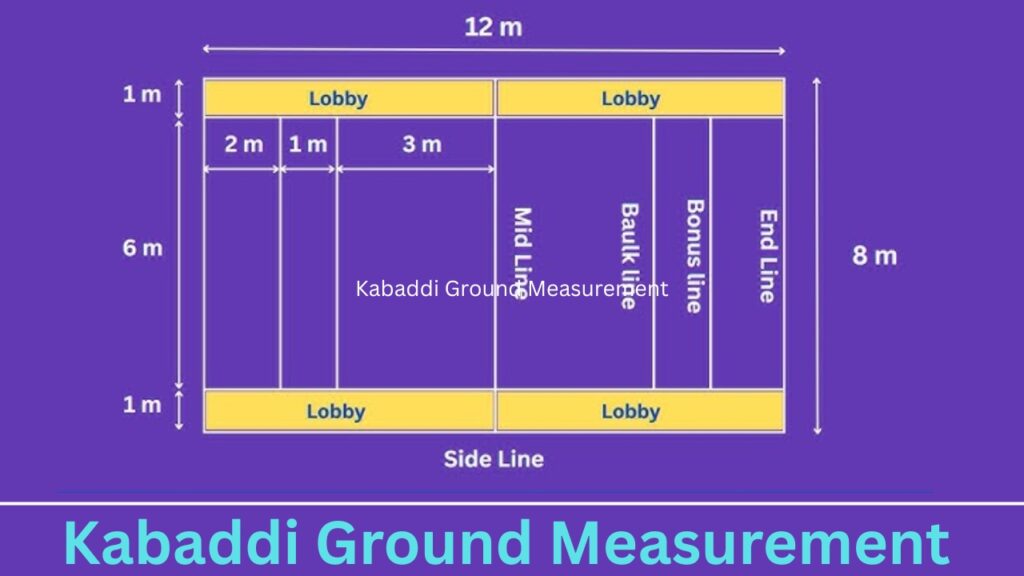
The kabaddi ground measurement is an essential part of the game. From the outside looking in, kabaddi may appear to be simple, but the playing court must have specific dimensions, lines, and zones that give referees and players clear guidelines on how to play the game while properly executing gameplay.
The basic layout contains the same baulk line, bonus line, midline, lobby, and end lines for men’s, women’s & junior competitions, but their sizes vary slightly. These measurements should be noted down by players, coaches, sports organisers, and anyone who is planning to construct a kabaddi court.
Standard Kabaddi Ground Size
According to general international kabaddi entities, the playing field is rectangular and split into two identical portions through the midline.
In senior men’s competition, the court length is typically 13 metres long and 10 metres wide.
For women’s and junior categories, a smaller court is used.
| Category | Court Length | Court Width |
| Senior Men | 13 m | 10 m |
| Senior Women | 12 m | 8 m |
| Junior Boys | 11 m | 8 m |
| Junior Girls | 11 m | 8 m |
These measurements refer to the main playing area and can be accompanied by additional space around the court for officials and players.
Kabaddi Ground Measurement in Feet
For people more familiar with feet, the standard dimensions can be converted approximately as follows:
| Category | Length | Width |
| Senior Men | 42.65 ft | 32.81 ft |
| Senior Women | 39.37 ft | 26.25 ft |
| Junior | 36.09 ft | 26.25 ft |
The men’s court of 13 m × 10 m is therefore approximately 42.65 feet × 32.81 feet.
Kabaddi Court Layout
A kabaddi court contains several important markings. Each line has a specific purpose during a raid or defensive play.
The main parts include:
- Midline
- Baulk line
- Bonus line
- End line
- Lobby
- Playing area
- Two halves
The court is divided into two equal sections, with one team occupying each half during play.
Kabaddi Ground Diagram
The basic structure of a standard men’s kabaddi court can be understood like this:
             13 Metres
    ┌─────────────────────────┐
    │         Lobby           │
    │ ─────────────────────── │
    │      Bonus Line         │
    │ ─────────────────────── │
    │       Baulk Line        │
    │                         │
    │         MIDLINE         │
    │                         │
    │       Baulk Line        │
    │ ─────────────────────── │
    │      Bonus Line         │
    │ ─────────────────────── │
    │         Lobby           │
    └─────────────────────────┘
             10 Metres
The exact line arrangement and measurements should be marked according to the competition’s official rules.
What Is the Midline in Kabaddi?
A midline is a horizontal line that divides the kabaddi court into two equal halves.
That means each half of a senior men’s 13-metre-long court measures 6.5 metres.
In a raid, the raider reaches the opponent’s side by crossing the midline from their half. Then the raider has to come back to their half, abiding by the rules of the game!
What Is the Baulk Line?
There is a baulk line situated toward the center of every half of this kabaddi court.
A raider cannot be tried and given out unless he touches the player or crosses the baulk line (except in one situation according to the rules).
In a standard court for senior men and women, the distance from the midline to the baulk line is usually 3.75 meters.
What Is the Bonus Line?
Further down the court, past the baulk line towards the opposing end, is a bonus line.
The standard length from the baulk line to the bonus line is 1 metre.
The bonus line is especially significant when the defending team contains six players on court. A raider crossing the bonus line can earn a bonus point according to applicable rules.
What Is the Lobby in Kabaddi?
Lobby: the lobes on two sides of the main play area.
Each lobby is, on average, 1 metre wide.
The lobby usually gets an update when there is contact between the raider and the defender. When activated, players move into the lobby where the raid is still in progress.
Kabaddi Ground Line Measurements
The court’s markings are designed to provide clear boundaries for players and officials.
| Court Feature | Standard Measurement |
| Men’s court | 13 m × 10 m |
| Women’s court | 12 m × 8 m |
| Men’s half | 6.5 m |
| Women’s half | 6 m |
| Lobby | 1 m |
| Baulk line from midline | 3.75 m |
| Bonus line from baulk line | 1 m |
Each competition category has its own regulations for measurements, so organisers must always work according to the most recent requirements from the relevant governing body.
Kabaddi Ground Surface
Kabaddi is played on different authorised ground surfaces depending on the level of competition.
Before modern professional and international competitions started to use synthetic mats, traditional kabaddi was mostly played on mud courts.
Kabaddi Mat
Professional kabaddi tournaments usually employ a special mat for playing. They are designed to provide a non-slip surface and can mitigate hazards caused by uneven terrain.
Mud Ground
A properly prepared mud surface can serve as the field of play in traditional kabaddi. The surface must be evened out and tamped so that there are no stones or other objects that may cause harm.
How to Mark a Kabaddi Ground
Step 1: Pick a Workable Surface
Choose a flat, clean, and level area without stones, holes, and objects of any kind.
Step 2: Measure the Court
Measure out a rectangle to mark the playing area; for senior men, it’s 13 metres × 10 metres.
Step 3: Draw the Midline
Use a ruler to measure the length of the court and then draw a straight line across the centre, dividing it into two halves.
Step 4: Mark the Baulk Lines
Measure 3.75 metres from the centre line on both sides, and make the baulk lines parallel to this midline.
Step 5: Add the Bonus Lines
Standard court layout and mark the bonus line 1 metre past both baulk lines.
Step 6: Mark the Lobbies
Construct the 1-metre-wide lobby areas on either side of the playing court.
Step 7: Mark the End Lines
Mark the boundary lines on both ends of the court to complete the playing zone.
Step 8: Check the Measurements
Finally, use a measuring tape to double-check each and every line and mark that the court is in the correct position when preparing it for play.
Also Read: Pro Kabaddi Points Table 2025 | Pro Kabaddi 2025 Schedule | Thyagaraj Indoor Stadium Delhi
School Level Kabaddi Ground Measurement
Depending on age and space, courts may be smaller for school competitions. The however must meet the specifications of the appropriate school, state, or national contest.
A small court can alleviate the pressure on younger players, making for an easier game to handle whilst giving a safer space to cultivate basic raiding and defensive skills.
Kabaddi Court vs Kho Kho Ground
Kabaddi and Kho Kho are both popular Indian sports, but their playing areas are different.
| Feature | Kabaddi | Kho Kho |
| Court Shape | Rectangle | Rectangle |
| Main Action | Raiding & Tackling | Chasing |
| Central Division | Midline | Central lane |
| Standard Men’s Kabaddi Court | 13 × 10 m | Different dimensions |
| Surface | Mat/Mud | Usually soil or synthetic |
The markings and dimensions should not be confused between the two sports.
Why Accurate Kabaddi Ground Measurement Matters
To have the ability to compete fairly, the ground needs to be measured to the proper court.
Accurate markings help:
- Raiders judge their position.
- Defenders understand boundaries.
- Referees make correct decisions.
- Teams practice in match conditions.
- Organisers maintain standard playing conditions.
- Players know about bonus and baulk areas
Measurement Error: Practice drills and tactical preparation are affected even by slight measurement errors of E, Strain or L.
FAQs about Kabaddi Ground Measurement
1. What is the standard kabaddi ground size?
The standard senior men’s kabaddi court measures 13 metres long and 10 metres wide.
2. What is the women’s kabaddi ground size?
A standard women’s kabaddi court generally measures 12 metres × 8 metres.
3. How wide is the kabaddi lobby?
The lobby is generally 1 metre wide on each side of the main court.
4. What is the distance between the midline and baulk line?
For senior men’s and women’s courts, the baulk line is generally 3.75 metres from the midline.
5. How far is the bonus line from the baulk line?
The bonus line is generally 1 metre beyond the baulk line toward the end line.
6. How big is a kabaddi ground in feet?
A senior men’s kabaddi court measuring 13 × 10 metres is approximately 42.65 × 32.81 feet.
Conclusion
Kabaddi ground measurement is significant in establishing a court that adheres to common playing standards. Dimensions of the pitch: Senior men’s courts are 13 × 10 metres, while women’s and junior courts are smaller. As you play, the midline, baulk line, bonus line and lobby all serve distinct functions!
Court markings enable more reliable training and competition, whether you are a player, coach, school organiser or sports enthusiast. Always verify tournament-level rules for building or marking a court before construction, as features can vary across competition tiers.
Also Read: Bengal Warriors vs Haryana Steelers | Noida Indoor Stadium | Last 5 Green Sleeve Winners in PKL